
Every business needs people with the right skills, but those needs can change quickly as an SME grows, introduces new technology or takes on different types of work.
You may find that only one employee knows how to complete an essential task, a key certificate is approaching expiry or your team needs new skills before the business can expand.
In this guide, we explain how to carry out a skills gap analysis and use the findings to support training, recruitment and workforce planning…
What is a skills gap analysis?
A skills gap analysis compares the skills your business currently has with those it needs now and in the future. It can be carried out across the whole company, within a team or for an individual employee. The process answers three simple questions:
- What skills do we need?
- What skills do we already have?
- Where are the gaps?
The findings can then guide decisions around everything from training to recruitment.
Why is skills gap analysis important for SMEs?
Smaller businesses often have less flexibility when important skills are missing. If knowledge is held by only one or two people, an employee leaving, taking holiday or being absent can cause significant disruption. Skills shortages can also make it harder to adopt new systems or take advantage of growth opportunities.
A skills gap analysis can help an SME identify training priorities, reduce its reliance on individuals, maintain important qualifications and prepare for future recruitment and growth.
The process does not need to be complicated. It simply requires a clear understanding of what the business needs and an accurate picture of the skills available.
How to conduct a skills gap analysis
1. Start with your business priorities
What is your business trying to achieve? Are you introducing new software, launching a service or expanding into another market? Are customer needs changing, or do employees require certain qualifications?
Your analysis should reflect these priorities. A business introducing a digital system may need stronger software and data skills, while a growing company may need more leadership and management experience.
Consider what you need today, as well as the skills that may become important over the next 12 to 24 months.
2. Define the skills needed
The next step is to identify the knowledge, abilities and qualifications required for each role. These could include technical skills, such as using specialist software, operating machinery or holding an industry certificate. They may also include communication, leadership and problem-solving.
Be specific. Instead of recording “IT skills”, list the exact systems or tasks an employee needs to use.
You can then rate each skill from no experience or basic understanding through to advanced knowledge and the ability to train others. This creates a consistent way to assess skills across the business.
3. Record the skills you already have
It’s important to build a clear picture of the skills available within your team. Use employee records, qualifications, training history, performance discussions and manager assessments. Employees should also be involved, as they may have useful experience that has never been formally recorded.
For example, someone may have project management experience from a previous role or speak another language that could support the business.
Our employee survey tools can support self-assessments, allowing employees to record their skills, qualifications and development needs. Used alongside manager feedback, these surveys can uncover valuable knowledge that may otherwise be missed.
4. Identify and prioritise the gaps
Look for important skills that are missing, tasks that too few employees can complete, knowledge that needs updating and certificates that are due to expire. You should also identify where essential knowledge is held by only one person.
Not every gap will be equally urgent. Prioritise those that affect compliance, health and safety, daily operations, customer service or business growth.
For example, an expiring compliance certificate may need immediate attention. Training more employees to use an essential system could be a medium-term priority, while developing future managers may form part of a longer-term plan.
How can an SME address a skills gap?
Training may be the most obvious solution, but it’s not the only one. Depending on the gap, you could:
- Introduce mentoring or job shadowing
- Share knowledge between employees
- Create process guides
- Give someone experience through a new project
- Recruit a new employee
- Use an external specialist
The right solution will depend on your budget, available time and how urgently the skill is needed.
For smaller businesses, internal knowledge sharing can be particularly useful. An experienced employee can train colleagues, reducing reliance on one person while developing their own mentoring or leadership skills.
Manage skills and maintain cover
A skills gap analysis is easier when employee skills, certificates and supporting documents are stored in one place. A simple skills matrix can support this by showing how skills are spread across the team, where knowledge is concentrated and whether essential tasks have enough cover.
Within HR Planner, the skills management module and reporting tools work together to make this process straightforward. As you record skills, certificates and custom skill types – from software knowledge and professional qualifications to machinery training or first aid – the reporting module can build a live skills matrix. This gives you an at‑a‑glance view of strengths, gaps and areas that may need attention.
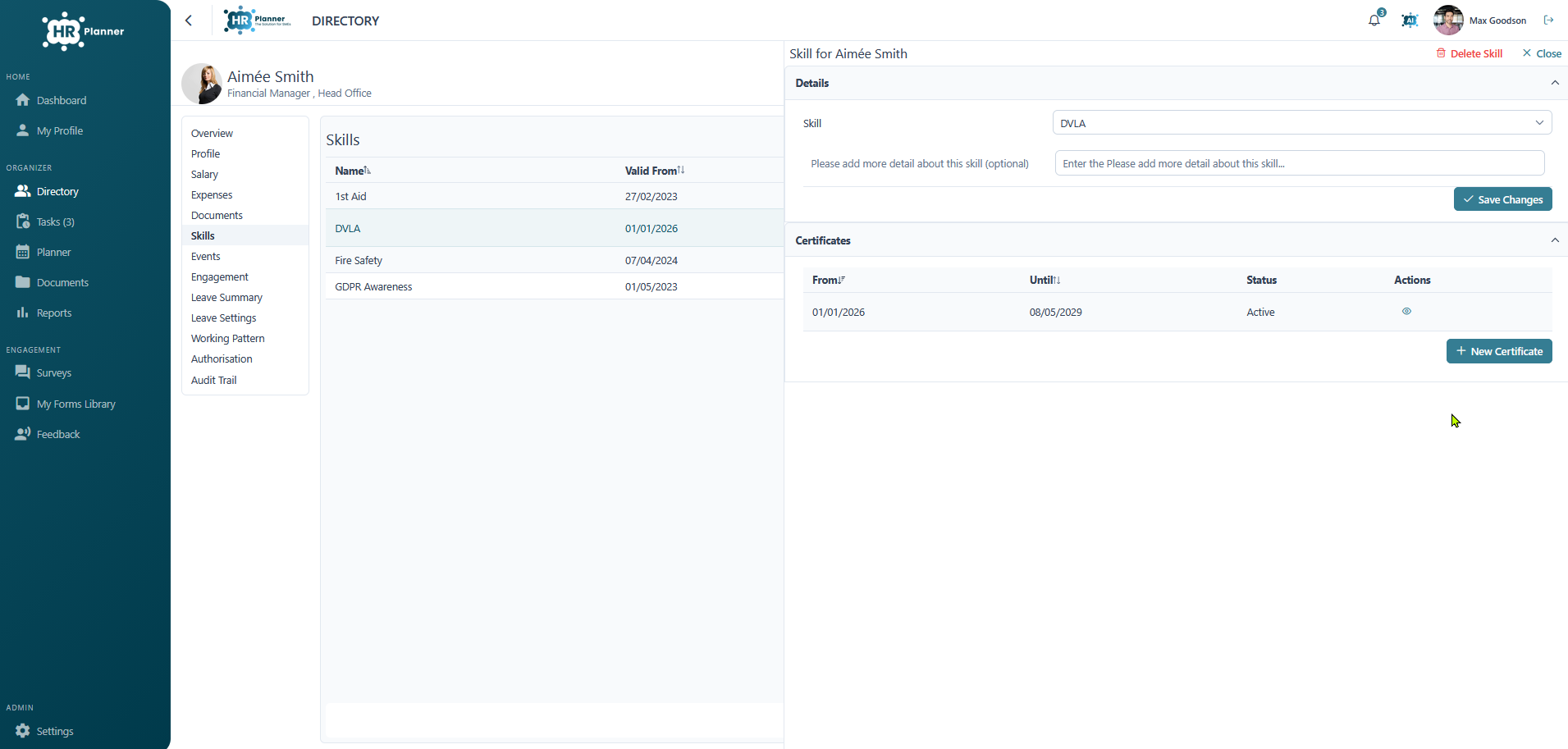
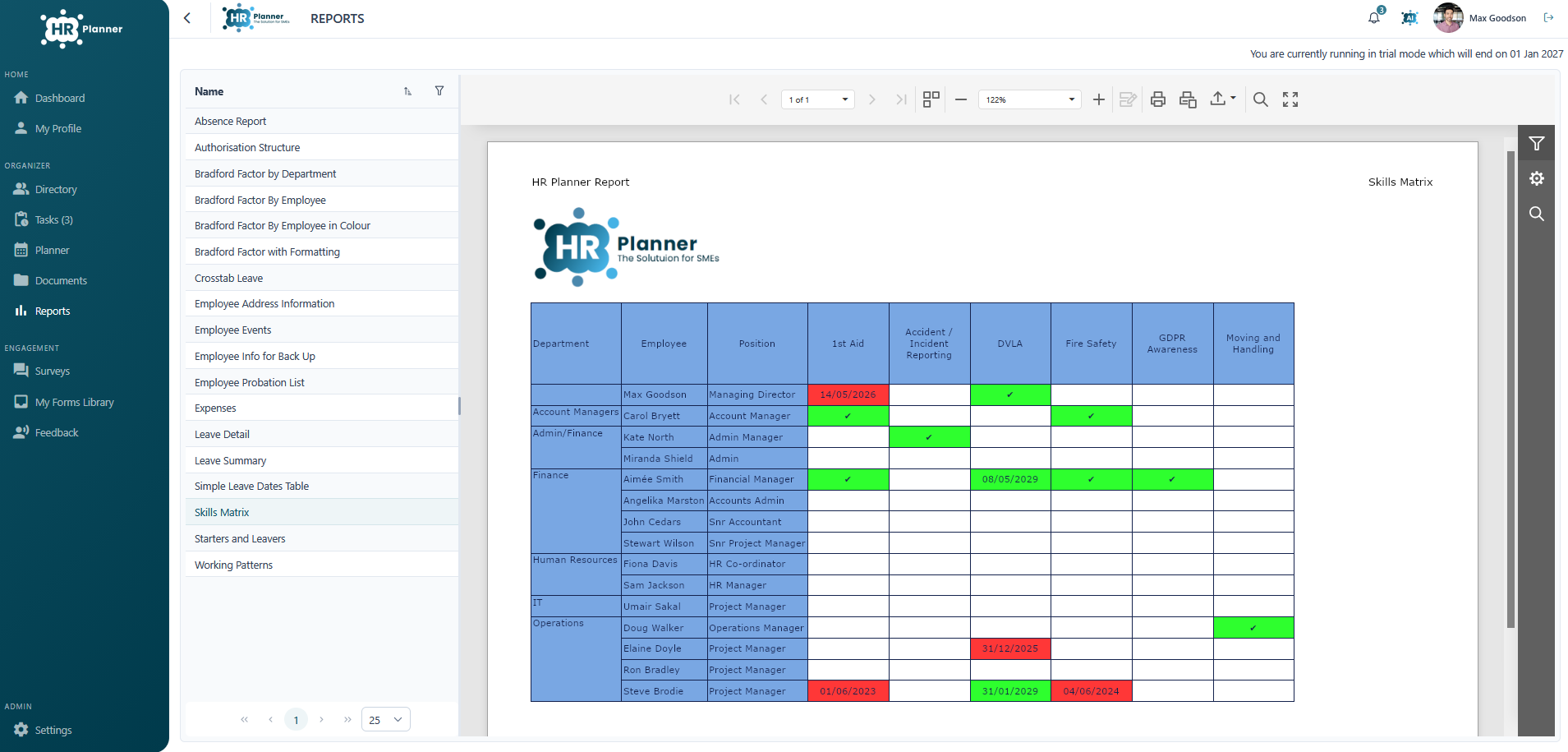
With these features, you can:
- Store supporting documents alongside each skill
- Enable notifications for when skills or certificates are due to expire
- Set low cover protection to ensure a minimum number of appropriately skilled employees are working on any given day
Review progress and take action
A skills gap analysis doesn’t end when training has been completed. Instead, it should form part of an ongoing process where you’re continuously monitoring where and how improvements could be made.
Once training is complete, start by reviewing whether employees feel more confident, whether managers have noticed an improvement and whether the training was useful. Our employee surveys can also be used here to gather feedback and identify where further support may be needed.
A wider skills review could then take place annually, with updates made when roles change, new technology is introduced, an experienced employee leaves or the business begins planning for growth. For each priority, record the skill needed, who requires it, the action to be taken, who is responsible and when it should be completed. You should also decide how success will be measured.
Keeping these records updated helps turn skills management into an ongoing process rather than a one-off exercise.
Ready to simplify skills management? Start your free 14-day HR Planner trial today, call 01252 636070 or email support@hrplanner.uk and see how HR Planner can help your business unlock its full potential.